

By Pauline Machado
The month of April brings with it attention and reflection on cancer prevention, which affects not only humans but also dogs and cats, impacting their quality of life and longevity. Therefore, just as with people, prevention and early diagnosis are fundamental to improving the chances of successful treatment and ensuring a healthy life for animals and peace of mind for their families.
Prevention in dogs and cats begins with simple care and regular check-ups with a veterinarian, such as a balanced diet and regular exercise. In addition, vaccination and parasite prevention can help reduce the chances of diseases that predispose pets to cancer.
Another very important factor is the attention that family members pay to possible early signs of cancer, such as lumps, wounds that do not heal, or changes in behavior.
To guide us on other ways to prevent cancer in dogs and cats, we spoke exclusively with the Veterinarian, Mariana Cazaux Pinho , graduated from the Federal Fluminense University – UFF, Master in Small Animal Clinical Practice and Reproduction, postgraduate in Clinical Pathology, Oncology, Hematology and Veterinary Hemotherapy.
Enjoy the interview and share it with friends and family!
Enjoy your reading.
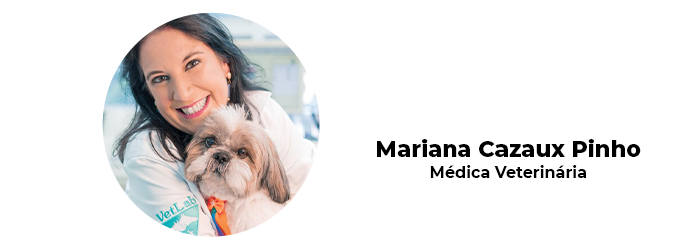
Pet Med – To begin, please explain to us what the most common risk factors are for the development of cancer in animals.
Mariana Cazaux Pinho – We can observe that the most common risk factors related to the development of cancer in animals include age, breed predisposition, viral infections (in the case of felines, the Feline Leukemia Virus – FeLV), sun exposure, environmental agents, toxins, pollution, and radiation. These factors can favor the development of neoplasms.
Pet Med – Are there certain breeds of dogs or cats that are more susceptible to cancer?
Mariana Cazaux Pinho – Several international studies have demonstrated a predisposition in some breeds to developing neoplasms, such as Boxers, Bernese Mountain Dogs, Golden Retrievers, Cocker Spaniels, etc. This can often be attributed to constant interbreeding and breed standardization, promoting the selection of mutated genes.
Pet Med – What are the early signs of cancer that dog and cat owners should be aware of?
Mariana Cazaux Pinho – We commonly observe the presence of rapidly growing skin nodules, weight loss, loss of appetite, bleeding, which may be oral, urinary or intestinal, as well as weakness and pale mucous membranes.
Pet Med – Does diet play a role in cancer prevention in animals? In what way?
Mariana Cazaux Pinho – The use of antioxidants in food, as well as the non-use of pesticides in food cultivation, can help in prevention. We should, therefore, avoid the use of dyes, processed meats, and pesticides in their food, which should also be avoided in our own diet.
Pet Med – What do you recommend regarding castration to prevent certain types of cancer, such as breast or testicular cancer, for example?
Mariana Cazaux Pinho – It is widely known that early spaying of female dogs can prevent the occurrence of breast cancer. However, it is only truly effective in very young bitches (before their first heat), and the absence of sexual maturation should be discussed individually between the veterinarian and the family. Regarding testicular neoplasms, which, although rare in dogs and cats, can indeed be prevented by spaying, this should be discussed individually between the family and the veterinarian.
Pet Med – Can exposure to sunlight or other environmental agents increase the risk of cancer in dogs and cats?
Mariana Cazaux Pinho – Animals that exhibit greater depigmentation in areas such as the face, eyelids, muzzles, ears, and abdomen, where there is also no fur to protect them, and which are more exposed to sunlight, may indeed be predisposed to the development of cutaneous neoplasms, such as squamous cell carcinoma, in both dogs and cats. Prevention can be achieved by using sunscreens specifically formulated for pets and avoiding sun exposure during peak sun hours.
Pet Med – What are some regular checkups that can help detect cancer early in dogs and cats?
Mariana Cazaux Pinho – Regular checkups can detect the early onset of thoracic or abdominal neoplasms through imaging tests such as ultrasounds, radiographs, echocardiograms, and CT scans. Blood tests are also commonly used to identify anemia and other abnormalities depending on the affected organs. Hormonal tests are also very useful in detecting neoplasms of endocrine origin. However, a physical examination performed by a veterinarian is essential for guiding and obtaining an accurate diagnosis as quickly as possible.
Pet Med – What habits should families adopt to ensure their pets have a healthier life and a lower risk of developing cancer?
Mariana Cazaux Pinho – A healthy diet, physical activity, avoiding obesity, avoiding sun exposure – for predisposed individuals, avoiding viral contamination, in the case of FeLV in cats, by restricting access to other potentially contaminated animals, also for dogs, with the aim of preventing contamination by transmissible venereal tumor. It is also important not to administer medications to prevent estrus, and injections in cats, thus avoiding the development of sarcomas at the injection sites. Avoid family breeding that may perpetuate mutated genes that may predispose to the development of neoplasms.
Pet Med – Finally, what are the warning signs that require immediate medical attention?
Mariana Cazaux Pinho – Family members should take their dogs or cats to the veterinarian immediately if they notice visible skin lumps, bleeding of any kind, loss of appetite, weight loss, fever, or lethargy.


