

Put Pauline Machado
Anyone who lives with cats has probably wondered why, just when the house is quiet, they seem to wake up with boundless energy. There are nighttime jumps, insistent meows, and runs around the house! All behaviors reported by many owners, but when this pattern goes beyond the limit, it's time to pay attention.
Feline nocturnal hyperactivity is not just a characteristic of the species; it can reflect behavioral, emotional, and even clinical causes, requiring careful and individualized attention from family members.
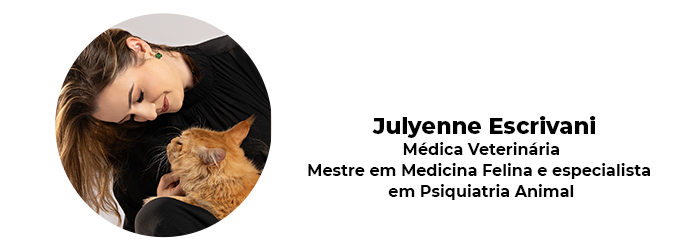
In this interview, the veterinarian Julyenne Escrivani , Master in Feline Medicine and specialist in Animal Psychiatry, explains the origins of this behavior, how it can be influenced from gestation to the domestic environment, and what are the main strategies to promote a more balanced routine between human rest and feline well-being.
Watch the interview and share it with friends and family who love cats!
Pet Med – To begin, tell us: is it true that cats have a different biological clock than we do? If so, how does this influence their nocturnal behavior?
Julyenne Escrivani – Yes, cats are essentially crepuscular, meaning that their peak energy and activity coincide with their main prey times: early morning and early evening, sometimes lasting until the early hours of the morning, depending on the cat. For example, if a cat was born to a mother cat with more nocturnal habits – remembering that 50% of genetics comes from the father – it may have a preference for crepuscular-nocturnal habits. The socialization phase, which lasts until the fourth month of life at most, also influences the cat's overall behavior and can affect these schedules.
In short, cats may already have preferences for mealtimes due to their gestation and early childhood, but this behavior can be shaped throughout their lives with the right techniques that don't punish the cat.
Pet Med – And what about the owners' routine? Does it directly influence the quality of sleep in cats?
Julyenne Escrivani – Yes, cats are part of the domestic environment, and the way their owners live directly influences their feline habits. Their atavistic nature stems from their ancestors, so they typically have energy peaks early in the morning and at dusk, which can be inconvenient for many owners. Ideally, you should try to expend the cat's energy during these times, and gradually modulate these behaviors with techniques so that, in a healthy way, their schedules become closer to those of humans without causing distress. A feline behaviorist can help in this process.
Pet Med – How to differentiate between normal feline nighttime behavior and hyperactivity that requires attention?
Julyenne Escrivani – Normally, when we engage in games with the cat, in the form of a hunt, as if it were chasing the toy at those times, late afternoon / early evening, for example, they get used to expending that energy at those times.
I always advise giving a significant amount of wet food afterward, which allows the cat to get used to this routine. Now, if even then, later at night, or even at dusk, the cat continues to show agitation, meowing a lot, pacing back and forth in the house, trying to interact with others – and those others don't show the same willingness, seeking the owner's attention in an atypical way, different from what the owner is used to, it's worth sounding the alarm and seeking help from a behaviorist to assess the situation. If they aren't also a clinical veterinarian, seek a specialist to rule out associated clinical problems, which are not uncommon. In my experience, these issues are always present.
Pet Med – What are the main environmental or emotional factors that can trigger nighttime restlessness in cats?
Julyenne Escrivani – Resource disputes between cats: we know that cats have individual habits, and that even when living with other cats and even other animals, they depend on solitary moments to perform species-specific behaviors, such as using the litter box, hiding in a safe place, and even hunting/eating, which for a cat is basically the same thing.
Clinical problems: some diseases, such as hyperthyroidism and hyperaldosteronism, for example, are associated with nighttime vocalization. Other factors such as pain, temperature changes where they live, reduced mobility, among others, can also influence it. When in doubt, whenever a cat changes its pattern, it's advisable to consult a specialist veterinarian for help. As I said before, it's not uncommon for clinical problems to be associated with behavioral changes – I see this every day.
Closed doors have a significant influence: cats are territorial, and whenever they can't access an area within their territory, they become alert, stressed, and anxious because they can't achieve their goal. They often feel frustrated, and this can lead to associated behaviors like vocalization. This intensifies because when we close a door, there's usually something or someone behind it making noise or movement, which attracts the cat's attention because it can't access that part of its territory at that particular moment.
Anxiety, frustration, and cognitive dysfunction: these are the emotional problems that most often trigger vocalization, especially at night, right after that energy surge that, in many situations, wasn't previously expended. Do you notice that this occurs alongside clinical problems? That's why clinical and behavioral aspects go hand in hand, and it's always necessary to evaluate both to successfully address the problem and help the cat and its family.
Pet Med – Do kittens and adult cats exhibit this behavior for different reasons? How does age play a role?
Julyenne Escrivani – Yes, puppies can usually do this because they miss the company of their mother and siblings, or when they arrive in a new home, or even due to structured introductions and need to spend time alone – the lack of structured interaction (twilight moments) to expend energy and allow them to rest more and get into the routine of the adults in the house from an early age.
Older adults, on the other hand, may develop common age-related diseases that involve vocalization, such as hyperthyroidism and hyperaldosteronism, as well as diseases that cause pain and discomfort, such as degenerative joint disease or chronic kidney disease, in addition to cognitive dysfunction that affects their perception of the environment.
Pet Med – So, health problems or chronic pain can manifest as restlessness at night? What signs warrant investigation?
Julyenne Escrivani – It's always the same, not just at night, but it gets worse at night because the temperature drops and, in many cases, they realize they're alone. So I often joke with my clients and say: cats don't break protocol; if they change anything, even subtly, in their behavior, investigate. Just like for us, any changes involving the body and mind cause strangeness, and since cats are stoic—that is, they tolerate pain, discomfort, or suffering without showing obvious signs—the first subtle changes are in their behavior. Like a good prey species, they can't show weakness (signs), so any alteration in their pattern shouldn't wait to seek specialized help. Often, when a cat shows signs of pain or any other problem, the disease itself is already established. I experience this daily.
Pet Med – What routine and environmental adjustments can help reduce nighttime hyperactivity naturally?
Julyenne Escrivani – Daily structuring. Understand that peak activity times are at dawn and dusk, try to coincide these times with the routines of humans and other animals in the house to play/expend the cat's energy during these times for around 30-40 minutes, preferably alone. We cannot forget that they hunt and eat solitarily, and immediately afterwards offer a quantity of wet food (still separate) as a positive reward. In this way, they will become conditioned to expend energy assertively at these times and are rewarded afterward. Conversely, at other times they conserve energy to expend it during these moments.
Pet Med – Is there room for integrative therapies, such as herbal remedies, homeopathy, or natural supplements, in this context?
Julyenne Escrivani – Yes, I work with all of them, and what can NEVER be overlooked is that all these alternatives are associated with behavioral therapies. In other words, first I structure the cats' routine, expend their energy, reward them positively, ensure there are no conflicts between the cats in the house or competition for resources, for example, and only then do I use therapies that will assist in this process. Simply using therapies without understanding that the cat needs everything else will not solve the problem. On the contrary, it can even worsen things in some ways.
Pet Med – When is the right time to intervene with therapeutic support? And what are the risks of ignoring the problem?
Julyenne Escrivani – As soon as you notice any change in your cat's behavior, even a subtle one—because, as I stated before, cats don't break protocol—and if something has changed, you need to investigate what caused that monotonous animal to resort to changing its behavior to protect itself, possibly. Ignoring this will worsen the initial problem, potentially triggering associated clinical and behavioral issues and making the original problem more difficult to identify and resolve.
Pet Med – For those seeking a balance between human rest and feline well-being, what would be an “ideal routine” for calmer cats at night?
Julyenne Escrivani – As I said, it's important to understand that their activity peaks are synchronous with their main prey. Therefore, the best time to expend their energy through hunting/playing coincides with these times. Furthermore, always offer a substantial amount of wet food as a positive reward from kittenhood, so that this becomes associated with the cat's routine from a young age.
Pet Med – Finally, if you feel it's necessary, use the space below to supplement your participation by adding any other information you consider important that wasn't covered during the interview.
Julyenne Escrivani – It's worth mentioning that cats typically don't vocalize as their primary form of communication; they are silent. Therefore, their main way of communicating is through smell, body posture, and sight.
Since they live in a domestic setting, they learn to meow to communicate with humans, because for practically everything they do, we talk to them, we respond verbally, and this serves as a stimulus. So, if you always respond to their meows by talking to the cats, or if you wake up at night to see what the cat wants, talk to it, and even give it food, for example, these are the main ways to intensify these behaviors.
Yes, there are more vocal cats like Siamese and Siamese mixes, but all cats learn that meowing gets them more attention and they take advantage of this. Try not to always respond, and redirect the cat's attention when it's meowing a lot to a toy, for example, or provide food enrichment so that it is distracted and "forgets" to meow at that moment. Do this during the day, because the more it learns to meow during the day, the more it will want to repeat it at night. For any nighttime behavior that needs to be modified, treatment begins during the day, and then we address the moment of nighttime dysphoria.


